Year end offers a practical opportunity to reduce taxable income, but only if you treat roof works correctly. Routine repairs and maintenance to keep a commercial roof watertight are usually tax deductible in the year they are done, while a full re-roof or structural upgrade is typically a capital expense claimed over many years under Division 43. This article explains how strata and property managers in Sydney can choose to document the right works at the right time.
Understanding the Critical Distinction: Repairs vs Improvements
The Australian Taxation Office applies a practical test that determines whether roof work reduces this year’s tax bill or spreads deductions across decades. Repairs and maintenance that remedy defects, damage or deterioration from using the property to earn income can be claimed in the year incurred. While improvements that make part of the property better, more valuable or change its character are capital expenses
For commercial roofs in Sydney, this distinction directly impacts cash flow and year end tax planning. Every dollar claimed as an immediate repair deduction reduces taxable income now. Every dollar classified as a capital improvement gets spread across 40 years at 2.5% annually under Division 43.
Common Roof Repairs (Immediately Deductible)
Roof repairs include work that restores an asset to operating condition without materially adding to its value or extending its life. For commercial buildings, deductible repairs typically include:
- Patching leaking seams or penetrations around roof mounted equipment
- Replacing a section of damaged flashing or slipped metal sheets
- Resealing expansion joints or parapet cappings
- Clearing blocked gutters or repairing downpipes
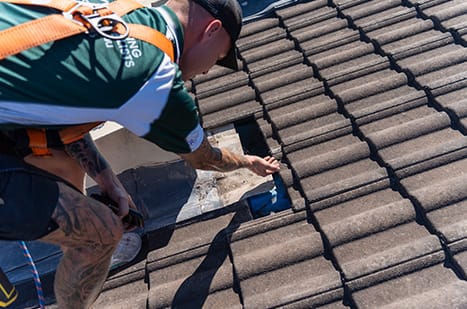
- Replacing isolated broken roof tiles or corroded fasteners
- Repairs to roof access hatches or safety equipment
These works keep the roof functioning as intended. They restore the asset to its previous operating condition without creating something fundamentally new.
Capital Improvements (Division 43 Deductions Over Time)
Capital expenses provide long term benefits to property by improving its value or extending its useful life, and include structural improvements, alterations and extensions. For commercial roofs, capital improvements usually include:
- Complete roof replacement or re-roofing with new materials
- Structural repairs that materially extend the roof’s lifespan
- Major changes to roof profile, pitch or drainage design
- Installation of new insulation systems that improve thermal performance
- Upgrading roof cladding to meet current NCC weatherproofing standards
- Adding new roof sections during building expansions
Mixed Works Require Itemised Documentation
Many roof projects combine repairs and capital improvements. A contractor might patch immediate leaks while also replacing an entire roof section that has reached the end of its life. If repairs and improvements are done simultaneously, property owners can only claim a deduction for repairs if they can separate the cost from improvements, and the ATO recommends asking for itemised invoices from builders or professionals carrying out works.
This is where professional documentation from your roofing contractor becomes essential. Ivy Roofing provides itemised quotes that clearly separate repair line items from capital replacement costs, making year end tax planning and accountant reporting straightforward.
Capital Works Deductions (Division 43) and Plant & Equipment (Division 40)
Understanding how different roof costs are classified under the tax system helps strata committees, property managers and building owners make informed decisions about timing and scope of works.
Division 43: Structural Elements and Fixed Improvements
Capital works deductions are income tax deductions an investor can claim for wear and tear that occurs to a building’s structure and items permanently fixed to the property, including structural improvements made during renovations. For commercial roofs, Division 43 typically covers:
- Roof structure, framing and support beams
- Roof cladding materials such as metal sheeting, tiles or membrane
- Permanently fixed waterproofing and flashing systems
- Roof drainage, including gutters and downpipes that are structurally integrated
- Permanent roof penetration seals and details
- Ducting for air conditioning systems that pass through the roof structure
Most commercial properties claim capital works deductions at 2.5% per year over 40 years, though some industrial properties or specific construction periods may qualify for a 4% rate. The deduction calculation starts from the date construction is completed, not from the date you purchased the property.
For a $100,000 commercial roof replacement, the annual Division 43 deduction would typically be $2,500 per year for 40 years. This is why proper classification matters for cash flow forecasting and capital works planning.
Division 40: Plant and Equipment Depreciation
Some roof-related items may qualify for faster depreciation under Division 40 as plant and equipment rather than capital works. Items like air conditioning units themselves depreciate under Division 40, while ducting for the same unit falls under Division 43, and this distinction can cause confusion because some parts qualify for plant and equipment depreciation, while other parts qualify for capital works deductions.
Examples of potential Division 40 items on commercial roofs include:
- Mechanical plant and HVAC equipment mounted on the roof
- Solar PV systems where eligible under tax rulings
- Removable roof access equipment or platforms
- Certain safety equipment or temporary installations
- Exhaust fans or ventilation equipment
The Importance of Professional Cost Allocation
For major roof projects that include both repairs, structural replacement and equipment installation, property owners should request a bill of quantities or itemised cost schedule that separates three categories:
- Repair costs: Deductible in full in the current year
- Capital works costs: Division 43 structural items with construction cost breakdown
- Plant and equipment: Division 40 depreciable items with equipment specifications
Ivy Roofing prepares comprehensive documentation packages for commercial and strata clients that include itemised quotes, condition reports, photographic evidence, and specifications formatted to support accurate tax classification by quantity surveyors and accountants.
Practical Year-End Tax Strategies and Recordkeeping
Strategic timing of roof works can legitimately maximise tax benefits when you understand the rules and document decisions properly.
Timing Repairs for Maximum Immediate Deduction
If your commercial roof needs both urgent repairs and eventual capital replacement, consider completing the deductible repairs before 30 June if cashflow permits. This captures the immediate deduction in the current financial year and protects the asset while capital replacement is planned and budgeted for the next period.
Before committing to year-end work, ensure:
- The repairs genuinely meet the ATO test for restoration to operating condition
- Works are completed and invoiced within the financial year
- Payment terms align with your deduction timing requirements
- The work genuinely needs to be done now rather than being artificially accelerated
Ivy Roofing maintains capacity for year-end emergency repairs and scheduled maintenance throughout June to help property managers meet financial year deadlines.
Obtaining Itemised Quotes for Tax Classification
When requesting quotes for commercial roof work, specify that you need line item separation between repairs and capital improvements. A quality itemised quote should show:
- Labour and materials broken down by repair activity vs capital replacement
- Clear descriptions that support the repair vs improvement classification
- Separate sections for compliance items such as scaffolding, edge protection and SWMS
- Pricing for any plant and equipment that might qualify under Division 40
- Quantities and specifications that support quantity surveyor cost estimation
Our commercial roof condition reports document existing defects with photographs and recommendations categorised by repair urgency and tax treatment, helping strata committees make informed decisions about which works to approve in which financial year.
Staging Works Across Financial Years
Where a full roof replacement is capital and cannot be deducted immediately, strategic staging can optimise tax outcomes:
- Current year: Complete urgent repairs that meet deductible criteria, document properly, and claim immediate deduction
- Next financial year: Proceed with planned capital replacement, establish Division 43 deduction schedule
- Documentation: Record staging decisions in committee minutes and maintenance plans to demonstrate tax planning legitimacy
This approach protects the asset now while managing capital works expenditure across budget periods. However, staging must reflect genuine operational needs. Artificially splitting capital projects into sham repairs risks ATO scrutiny and disallowed deductions.
Essential Documentation Checklist for Accountants and Auditors
Proper recordkeeping strengthens the defensibility of your tax claims and satisfies ATO requirements. For every roof project, retain:
- Contractor invoice: Itemised with clear descriptions of repair vs capital works
- Before and after photographs: Visual evidence of defects repaired and final condition
- Detailed scope of works: Written specifications of materials and methods
- Safe Work Method Statements: Required for work where the fall risk exceeds two metres
- Anchor certifications: For any roof access or edge protection anchor installations
- Compliance certificates: SafeWork NSW documentation, NCC product approvals
- Statutory approvals: Development consents where required for major alterations
- Warranties: Covering workmanship and materials
- Payment evidence: Receipts, bank statements, credit card records
- Committee minutes: For strata properties, documenting approval decisions and rationale
The ATO recommends retaining tax records for five years from the date of lodgement. For capital improvements claimed under Division 43, keep construction documentation for the entire claim period or until property sale, whichever comes first.
Why Strata and Property Managers Choose Ivy Roofing for Tax Smart Commercial Roof Work
Maximising legitimate tax deductions requires professional roofing contractors who understand the documentation accountants need and the compliance requirements SafeWork NSW enforces.
Itemised Quotes and Condition Reports That Support Correct Tax Classification
Ivy Roofing provides detailed commercial quotations that separate repair activities from capital replacement costs. Our roof condition reports document existing defects with photographs, condition ratings and recommendations categorised by urgency and expected tax treatment. This upfront clarity helps strata committees and building owners make informed decisions about which works to approve and when.
Our quotations include:
- Line by line breakdown of labour and materials
- Clear descriptions supporting repair vs improvement classification
- Separate sections for compliance costs, such as scaffolding and edge protection
- Specifications formatted for quantity surveyor review
- Options for staged delivery across financial years
Repairs and Emergency Works for Immediate Deduction
When urgent repairs are needed to protect your commercial asset and capture year end tax deductions, Ivy Roofing provides rapid response emergency repair services across Sydney. Our experienced roofing specialists complete leak repairs, storm damage remediation and critical maintenance work that qualifies for immediate tax deduction, documented properly with itemised invoices, before and after photographs and detailed scope descriptions.
Emergency services available include:
- Leak detection and repair to prevent tenant disruption and asset damage
- Storm damage assessment and temporary weatherproofing
- Failed flashing or penetration seal repairs
- Gutter and drainage blockage clearance
- Safety equipment repairs to maintain compliant roof access
Sydney Commercial and Strata Roofing Expertise
Ivy Roofing has delivered commercial and strata roofing solutions across Sydney for over 20 years. Our team understands the unique requirements of multi-owner properties, strata legislation, committee approval processes and the importance of minimising tenant disruption. We work regularly with strata managers, facilities managers, commercial asset managers and accountants who value our attention to proper documentation and tax aware project delivery.
Get your year-end tax position organised with a roof condition audit and itemised quote from Ivy Roofing. We separate deductible repairs from capital items, provide photographic condition reports and supply the SWMS and compliance certificates your accountant will want. Book a commercial audit today at 02 9674 4556or visit our commercial services page.