A strata committee meeting rarely gets exciting until someone brings up the roof. Then, suddenly, everyone has an opinion about who’s supposed to be looking after it, whose budget it comes from, and why nobody noticed the problem sooner.
If you sit on a strata committee or manage a strata property in Sydney, this probably rings a bell. Roof maintenance is one of those responsibilities that falls into a grey area more often than it should, and winter is usually when that grey area becomes a real problem, because that’s when Sydney’s sustained rain finds every weak point that’s been quietly building for months.
Who Is Actually Responsible for the Roof
In most strata schemes in NSW, the owners corporation is responsible for maintaining common property, and the roof almost always falls under that umbrella. Individual lot owners are generally not responsible for structural roofing elements, though this can vary depending on the specific by-laws registered for the scheme. This is worth checking properly rather than assuming, particularly for older buildings where the strata plan might not clearly define boundaries between common property and individual lots.
What this means practically is that the strata committee, often through a managing agent, needs to be proactive about scheduling inspections and maintenance rather than waiting for a leak to force the issue. Reactive roof management tends to cost owners more in the long run, and it can also create disputes between owners if damage affects individual units differently.
Why Winter Is the Season That Tests a Strata Roof
Sydney winters bring long stretches of steady rain rather than short, sharp storms. That kind of sustained weather puts pressure on a roof in a different way than a summer downpour. Small issues that might not show up during a brief burst of rain can be exposed over several days of continuous exposure, particularly on the flat or low-pitch sections common on many strata buildings.
Older strata buildings across Sydney, especially those built from the 1970s through the 1990s, often have roofing systems that were never designed with today’s rooftop additions in mind, things like satellite dishes, air conditioning units, or solar panels added well after the original build. Every one of those additions is a potential penetration point, and if it wasn’t properly flashed and sealed at installation, winter rain is usually what reveals the problem.
What Should Be Checked Before Winter Sets In
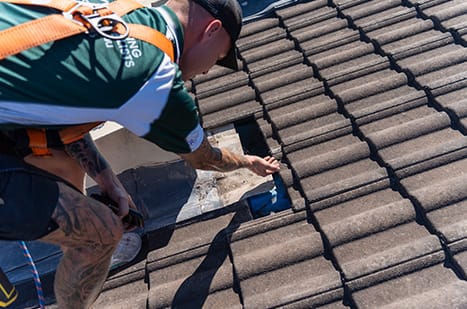
A proper pre-winter maintenance check for a strata roof typically covers:
- Roof membrane and tile condition, looking for cracking, lifting, or any areas where wear has become visible over the past year.
- Flashing around all penetrations, since this is one of the most common failure points on strata roofs with multiple rooftop additions.
- Gutters and downpipes, checking for blockages from leaf litter or debris, which is a common issue on properties with established trees nearby.
- Common property drainage, confirming water is actually moving away from the building rather than pooling near parapets or low points on flat sections.
Getting this done in autumn, before the wettest part of the year sets in, gives the committee time to budget for any repairs properly rather than approving emergency work under pressure.
Why Documentation Matters for Strata Committees
One thing that’s often overlooked is how important a written inspection report becomes when it comes time to budget for repairs or make a case to owners for spending on maintenance. A verbal assessment doesn’t hold much weight at an AGM. A documented report, with clear findings and photos, gives the committee something concrete to work from and makes it easier to justify the spend to owners who might otherwise question why money is being allocated to something they can’t see.
It also matters if a dispute arises later about when a problem started or whether it was reasonably foreseeable, which can come up in insurance claims or disputes between the owners corporation and individual lot owners over damage.
FAQ
Who pays for roof repairs in a strata building in Sydney? Generally, the owners corporation, since the roof is typically classified as common property, though this can depend on the specific by-laws for the scheme.
How often should a strata roof be inspected? Twice a year is a sensible baseline for most buildings, with an additional check after any significant storm event.
Can individual lot owners request their own roof repairs? Usually not directly, since roofing repairs on common property need to go through the owners corporation, though this varies by scheme.
What happens if a leak affects one unit more than others? This can get complicated and often depends on the cause of the leak and the specific by-laws, which is why proper documentation of the roof’s condition matters.
Does strata insurance cover roof damage? This depends on the policy and the cause of the damage, and it’s worth checking coverage details with the strata’s insurer directly.
How can a strata committee budget for roof maintenance? Regular inspections with documented findings make it much easier to plan and justify maintenance spending well before major repairs become necessary.
Ivy Roofing is a Sydney-based roofing company specialising in high-quality roof repairs, restorations, and replacements. We work with strata committees and property managers across Sydney to keep common property roofs properly maintained. Get in touch with us to arrange a strata roof inspection.